Tracing the scale of the unseen: from trans-species atmospheres to minuscule molecules
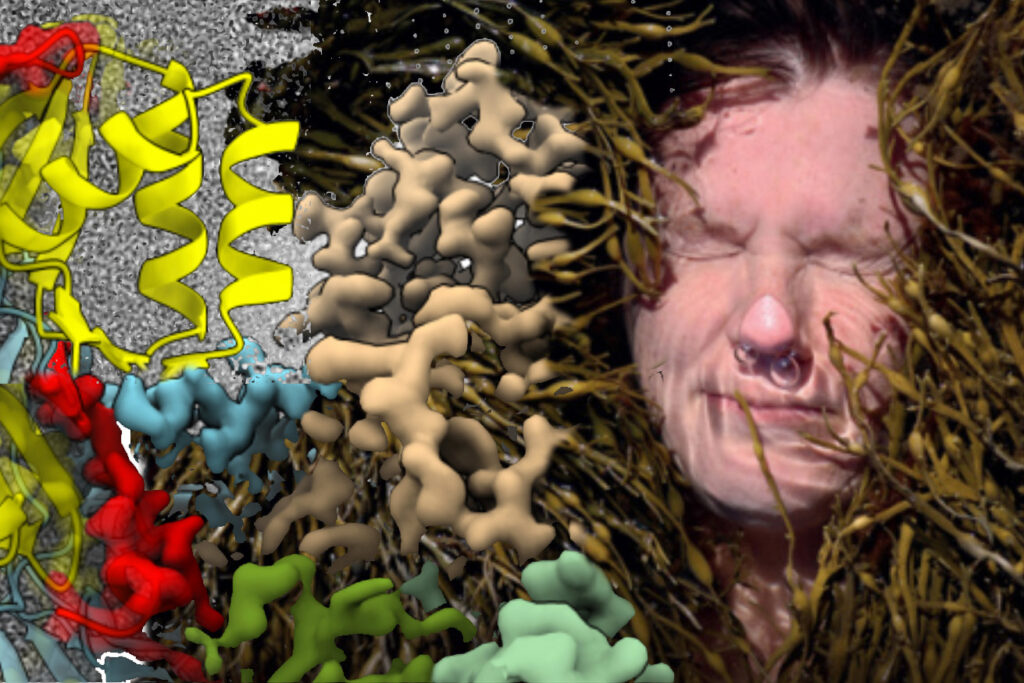
This workshop had us look at the world from its two extremes: the macroscopic domain of the invisible yet tangible ethical relationships that entangle researchers with their subjects of study, and the microcosm of molecular cell components that, although imperceptible, we need to see, so we can understand how life keeps humming along.
Atmospheres of ethical feeling across species
Our first text, which skewed a bit more academic and esoteric than our usual fare, probed mysterious auras that can arise around researchers as they interact with their subjects of study. The ethical treatment of animals in scientific and medical research is, of course, already well-travelled terrain. This text took things much farther, and took a more philosophical approach. This text argued that when a researcher studies something—including other human beings and animals, but also parts of animals, bacteria, plants, and perhaps most surprisingly, even inanimate objects—an ethical relationship inevitably arises between the observer and the observed. Even when studying inanimate objects, the text argued, the aesthetic qualities of objects create ethical feelings in the observer that can affect the process of observation. These “affective atmospheres”, the author wrote in an introductory note,
are like invisible feelings in the air that we can sense all around us, generated through the combined presence of both people, animals, and aesthetic objects. However, they don’t stay stuck to one thing. They sort of float and spread, and we can feel affected by them even if we don’t always notice them right away. I like to think of ethical situations arising out of affective atmospheres through the analogy of Ms. Peregrin’s School for Peculiar Children, as an ability to know/sense some extraordinary elemental forces as these are taking shape around us.
Dramatizing the history of structural biology
In the second text, we delved into the history of microscopy through the lens of the object of inquiry. In an imaginative take on the inner workings of the potassium channel, we discovered what it might feel like for molecules to be probed and prodded by us humans. We learned how their secrets remained hidden until at last a technique was invented that allowed the human "giants" to truly perceive their intricate magnificence – and how that quietly and steadily makes life possible.
What followed was a lively discussion around anthropomorphizing inanimate objects: do we risk projecting intentionalities where there are none, or is it okay as a method for bringing complex subjects to life that might otherwise remain dry and inaccessible?
Composite image: Structural biology, John Innes Centre & person in seaweed, from AI podcast episode Multispecies Ethnography in Design Research and Practice.